

Mole mapping is not covered by OHIP anywhere in Ontario, including London. It is classified as a private, preventive service, so patients pay out of pocket, though many extended health plans will reimburse part of the cost.
TL;DR
- OHIP does not fund mole mapping because it is preventive, not diagnostic.
- A doctor-flagged suspicious mole is a different situation, that assessment can be OHIP-covered.
- At South London Mole Clinic, a full digital skin imaging session with IntelliStudio costs $695 + HST.
- No referral is required to book mole mapping in Ontario.
- Extended health and HSA/FSA plans often reimburse part of the fee, always confirm directly with your provider.
What Is Mole Mapping, Exactly?
Mole mapping is a non-invasive way to photograph and track every mole on your body over time. It combines high-resolution total body photography with close-up dermoscopy to build a detailed skin baseline.
At South London Mole Clinic, this baseline becomes the reference point for every future visit.
- We photograph your skin in full using our IntelliStudio system.
- Any mole worth a closer look gets magnified dermoscopic imaging.
- New moles and subtle changes stand out clearly against your stored baseline.
This is far more reliable than relying on memory or comparing old phone photos.
How a Mole Mapping Appointment Works
Every appointment at our clinic follows the same four-step process, so your images are consistent and comparable at every visit.
- We talk first. Your skin history, risk factors, and any moles on your mind.
- Total body imaging. IntelliStudio captures clear, high-resolution photos across your skin.
- Digital dermoscopy. Any mole worth a closer look is magnified and documented.
- Your baseline. Images are stored securely and compared at your next visit.
Most sessions run about 30 to 45 minutes, depending on how many moles we document.
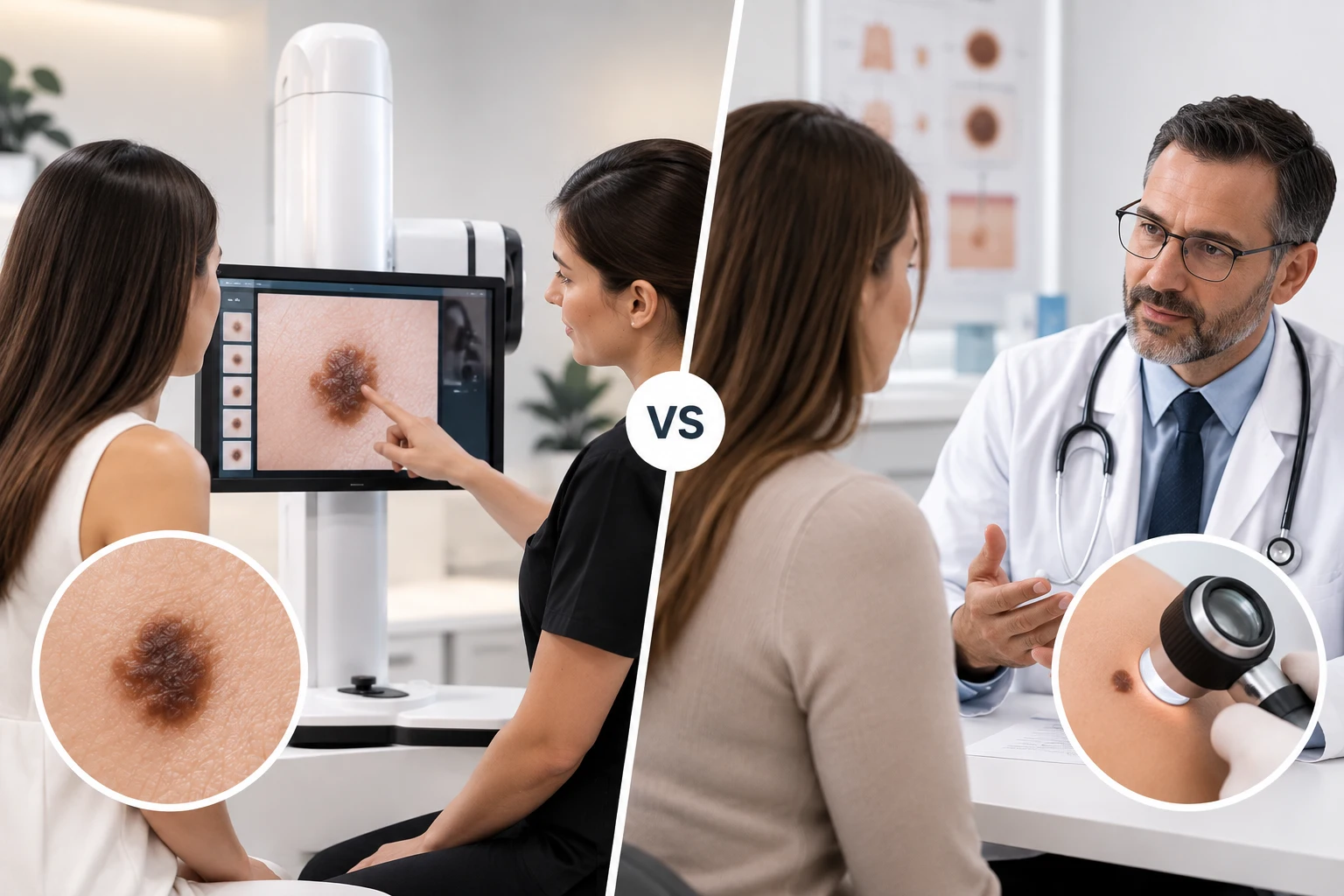
Mole Mapping vs a Regular Mole Check
A regular mole check is a quick visual look during a routine visit. Mole mapping is a dedicated, photographic baseline of your entire skin.
- A five-minute glance at a mole during a physical is not the same as a documented, side-by-side image comparison.
- Mole mapping is built for long-term tracking, not a one-time opinion.
- It works alongside a clinical exam by a nurse practitioner, not in place of one.
Pro tip: if you already have one mole that is actively changing, bleeding, or growing, book a direct assessment rather than waiting for a scheduled mapping session.
Does OHIP Cover Mole Mapping in Ontario?
No. OHIP does not cover mole mapping anywhere in Ontario, because it funds medically necessary care, not preventive screening.
OHIP pays for services tied to a specific, physician-identified concern. Mole mapping is designed for patients who want a baseline before any concern exists, which places it outside that definition.
- A patient with 50+ moles and no current concern: not covered.
- A patient who simply wants annual peace-of-mind imaging: not covered.
- A patient whose doctor spots one changing, irregular mole during an exam: that assessment can be covered.
Why “Medically Necessary” Is the Deciding Factor
OHIP draws a firm line between preventive screening and medically necessary assessment, and that line decides what gets covered.
- Medically necessary means a physician has already identified a specific lesion of concern.
- Preventive means you are checking healthy-looking skin just in case, which OHIP does not fund regardless of your personal risk profile.
- This rule applies evenly across every Ontario clinic, it is not specific to any one provider.
When a Mole Exam Does Become OHIP Covered
A mole-related visit can shift into OHIP-covered territory once a physician documents a clinical concern.
- A family doctor visit to assess a changing or symptomatic mole is OHIP-covered.
- A dermatologist consult via referral for a suspicious lesion is OHIP-covered.
- Any resulting biopsy or medically necessary removal is also OHIP-covered.
If you are unsure which path applies to you, our guide on private mole clinic vs dermatologist referral in Ontario walks through both routes in more detail.
What Does Mole Mapping Cost in Ontario?
Mole mapping in Ontario generally costs between $150 and $800 per session, depending on the clinic, technology, and how many moles need close attention.
- Basic single-lesion reviews sit at the lower end of that range.
- Full-body mapping with advanced digital dermoscopy sits at the higher end.
- Follow-up sessions are often priced lower than an initial baseline visit.
Typical Price Ranges Across Ontario
Pricing varies by clinic, technology, and how the session is structured.
- Basic mole check or single-lesion review: lower end of the range.
- Standard full-body mole mapping: mid-range pricing.
- Advanced digital systems with detailed imaging archives: higher end of the range.
For a closer breakdown by service type, see our dedicated page on mole mapping cost in London, Ontario.
What’s Included in a $695 + HST Session at South London Mole Clinic
A full digital skin imaging appointment at our clinic is $695 + HST, paid when you book.
- High-resolution total body photography.
- Polarised light digital dermoscopy of any mole that needs a closer look.
- A secure, private baseline stored for comparison at future visits.
- A conversation with your nurse practitioner about what the images show.
Pro tip: payment is taken at booking, and because this is a private service, it is not billed to OHIP. Check current pricing on our price page before your visit.
Can Insurance or an HSA Help Cover the Cost?
Mole mapping is not OHIP-covered, but it may be partially reimbursed through extended health benefits or a Health Spending Account.
Coverage depends entirely on your specific plan, so this is worth confirming before you book rather than after.
Checking With Your Extended Health Plan
A quick call to your benefits provider before your appointment can clarify what is reimbursable.
- Ask specifically about “preventive dermatology screening” or “mole mapping,” a generic “skin exam” line item may not apply.
- Ask whether a doctor’s note is required for reimbursement.
- Request an itemized receipt from our clinic after your visit, insurers typically need a detailed invoice.
Using an HSA or FSA for Mole Mapping
Health Spending Accounts sometimes classify mole mapping as an eligible medical expense even when a standard plan does not cover it.
- Check your HSA/FSA eligibility list before booking.
- Keep your itemized receipt for submission.
- Submit within your plan’s claims window, many plans require submission within a set number of months.
We cannot guarantee reimbursement amounts since every plan is different, your provider is the only reliable source for that number.
Who Should Consider Mole Mapping?
Mole mapping is worth considering if you have risk factors that make self-tracking difficult or unreliable.
It may be a good fit if any of the following applies to you:
- You have 50 or more moles, or moles that look large or irregular.
- You or a close relative has had melanoma or another skin cancer.
- You have fair skin, freckles, or red hair, and burn easily.
- You had significant sun exposure as a child, past sunburns, or used tanning beds.
- You have moles in spots that are hard to watch yourself, like your back or scalp.
- Your immune system is weakened, or you take medication that lowers it.
This list is general guidance, not a diagnosis. Whether mole mapping is the right choice for you depends on a conversation with a qualified clinician.
What Happens If Something Suspicious Is Found?
If your nurse practitioner notices something that needs a closer look, they will explain the next step directly, which may include a referral or a biopsy.
- Mole mapping is a monitoring tool, not a diagnostic test.
- It does not replace a clinical skin exam or a biopsy.
- If a mole looks suspicious, our team will guide you toward the appropriate next step, in some cases that means referring you into the OHIP-covered assessment pathway.
If you notice pain, bleeding, rapid growth, or a sudden change in a mole between appointments, book an in-person assessment rather than waiting for your next scheduled session.
Do You Need a Referral for Mole Mapping in Ontario?
No, you do not need a referral to book mole mapping at South London Mole Clinic.
- You can book directly online.
- A referral is only required if you want an OHIP-covered dermatologist assessment of a specific, already-flagged lesion.
- Skipping the referral step is common for patients who want a faster, private baseline rather than waiting for the public system.
How Often Should You Book a Mole Mapping Session?
Many patients return every 6 to 12 months so their images can be compared against their existing baseline.
- Your nurse practitioner will suggest a timing that fits your personal risk level.
- Higher-risk patients often benefit from the shorter end of that window.
- Lower-risk patients may be comfortable with an annual visit.
This interval is a general guideline. Your clinician can adjust it based on your history and what shows up in your images.
Mole Mapping at South London Mole Clinic
At South London Mole Clinic, mole mapping is delivered by qualified nurse practitioners under the clinic’s nurse practitioner-led model, founded by Pinkal Gandhi.
- Every session runs on our dedicated IntelliStudio imaging system.
- Photos are stored securely and privately as your personal skin baseline.
- Nothing about the appointment is invasive.
The IntelliStudio System
IntelliStudio is the imaging system behind every mole mapping appointment at our clinic.
- It captures standard, high-resolution photos of your skin.
- It pairs those photos with polarised light dermoscopy at high magnification.
- Because every visit is photographed the same way, images line up cleanly for comparison, and small changes that are hard to catch by eye show up clearly on screen.
How to Prepare for Your Appointment
A few simple steps help us capture the clearest possible baseline.
- Come with clean skin, and skip makeup, foundation, and nail polish that day.
- Leave self-tanner off for about two weeks before your visit.
- Take off jewellery and tie long hair back.
- Wear underwear you are comfortable being photographed in.
- Skip dark socks, and shave areas where hair hides the skin if you can.
- Jot down any moles you would like us to pay attention to.
If you are weighing mole mapping against removal of an existing mole, our page on mole removal in London, Ontario covers that separate procedure in detail.
For a broader look at skin cancer screening options in the region, see this related resource on skin cancer screening in London, Ontario.
Frequently Asked Questions
1. Is mole mapping covered by OHIP?
No. Mole mapping and digital skin imaging are private services in Ontario, including London, and are not covered by OHIP. The fee is $695 + HST at our clinic, taken at booking.
2. Do I need a referral for mole mapping?
No. You can book directly online without a referral from a family doctor. A referral only matters if you need an OHIP-covered dermatologist assessment of a specific, already-flagged lesion.
3. Does mole mapping hurt?
No, it is completely non-invasive. A small handheld dermoscope rests gently on the skin for close-up images, and nothing breaks the surface.
4. How often should I get mole mapping done?
Many people return every 6 to 12 months to compare against their baseline. Your nurse practitioner will suggest a timing based on your personal risk factors.
5. What is the difference between mole mapping and mole removal?
Mole mapping photographs and monitors your moles over time, while mole removal is a separate procedure to take a mole off. Many patients map first, then remove anything that needs it.
Book Your Mole Mapping Appointment in London, Ontario
If you are weighing whether to pay privately for mole mapping, a conversation with our nurse practitioner-led team can help you decide with confidence.
- Full digital skin imaging with IntelliStudio: $695 + HST.
- No referral required.
- Private, secure image storage as your personal skin baseline.
Book your mole mapping appointment at South London Mole Clinic, or contact us at (519) 800-4518 with any questions before you book.
This article is general information, not medical advice. Whether mole mapping is right for you depends on a clinical consultation with a qualified provider.




Leave A Comment